Dubai vs Abu Dhabi vs Other UAE Emirates: Where to Invest in 2026
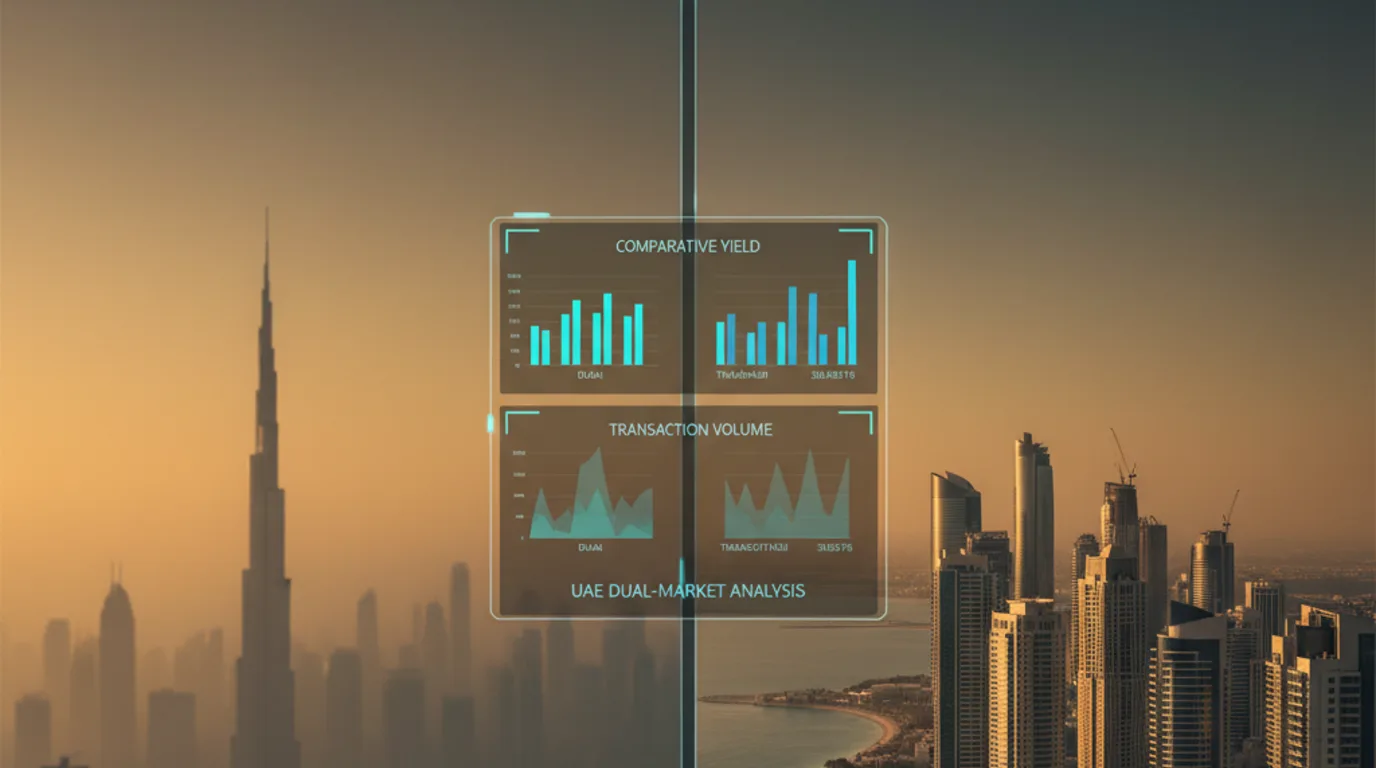
Emirate comparison
Updated 22 Oct 2026 · first report free, then USD 1 per check or 5 for USD 5. DLD/Ejari totals and medians move every month — verify numbers in Dubai REST / Pulse before wiring money.
In one minute
Dubai vs Abu Dhabi: The Core Split
Two capital markets, one country — and five more emirates with their own registers.
Emirate A
Dubai
- Market typeTransaction-led
- 2024 volume170k+ deals
- RegisterDLD + Ejari
- Developers600+ registered
- Data depthBuilding-level public
Volume, secondary depth, and DLD transparency — best for data-driven buyers who may need to exit.
Emirate B
Abu Dhabi
- Market typeFundamentals-led
- 2024 volume~20k deals
- RegisterADREC + Tawtheeq
- DevelopersAldar-dominated
- Data depthSummaries > unit tape
Lower churn, government-anchored tenants, Aldar disclosure — best for stability over maximum yield.
Dubai is transaction-led: high volume, active secondary market, investor-heavy buyer mix, and a developer ecosystem competing for attention. Abu Dhabi is fundamentals-led: lower volume, more end-users, Aldar-dominated pipeline, and ADREC data that is harder to pull at unit level than DLD.
All UAE Emirates at a Glance
Seven emirates, seven registers — fees and title types are not interchangeable.
Dubai
- Register
- DLD + Ejari
- Yield
- 7–10%
- Liquidity
- Highest
- Entry
- Wide range
Abu Dhabi
- Register
- ADREC + Tawtheeq
- Yield
- 6–8%
- Liquidity
- Moderate
- Entry
- Premium zones
Sharjah
- Register
- SRERD
- Yield
- 7–10%
- Liquidity
- Thin resale
- Entry
- Below Dubai
Ajman
- Register
- ARRA
- Yield
- 8–11%
- Liquidity
- Very thin
- Entry
- From ~AED 300k
Ras Al Khaimah
- Register
- RAKERD
- Yield
- 7–9%
- Liquidity
- Off-plan heavy
- Entry
- −30% vs Dubai waterfront*
UAQ / Fujairah
- Register
- Local municipality
- Yield
- 6–9%
- Liquidity
- Minimal
- Entry
- Project-specific
| Emirate | Register | Foreign title | Transfer fee | Gross yield band | Resale liquidity | Typical fit |
|---|---|---|---|---|---|---|
| Dubai | DLD + Ejari | Freehold (60+ zones) | 4% DLD | 7–10% | Highest | Yield + exit depth + DLD due diligence |
| Abu Dhabi | ADREC + Tawtheeq | Freehold (9 investment zones) | ~2% ADREC | 6–8% | Moderate | Stability + Aldar-led pipeline |
| Sharjah | SRERD | Usufruct / leasehold (100 yrs) + select freehold | ~2% (verify SRERD) | 7–10% | Thin secondary | Lower ticket + yield (title-type due diligence) |
| Ajman | ARRA | Freehold (designated zones) | ~2–3% (verify ARRA) | 8–11% | Very thin | Lowest entry + hold-to-rent |
| Ras Al Khaimah | RAK Land Dept / RAKERD | Freehold (Al Marjan, Al Hamra, Mina Al Arab) | ~2% (verify RAKERD) | 7–9% | Growing, off-plan heavy | Tourism / lifestyle + early-stage upside |
| UAQ / Fujairah | Local municipality | Limited designated zones | Varies | 6–9% (project-specific) | Niche | Specific use-case only |
Dubai
4%
DLD
Buyer often pays full 4%
Abu Dhabi
~2%
ADREC
Verify at transfer
Sharjah
~2%
SRERD
Title-type dependent
Ajman
~2–3%
ARRA
Project-specific
RAK
~2%
RAKERD
Often below Dubai
Liquidity: Dubai by a Wide Margin
Transaction volume drives price discovery and exit confidence.
Dubai ~170k+ transactions in 2024 vs Abu Dhabi ~18–22k. Northern emirates indexed from market depth, not exact DLD counts.
Price discovery
High-volume markets produce reliable DLD medians — thin markets swing on single deals.
Exit speed
JVC or Business Bay: active buyer pool. Yas or Al Reem: functional but thinner.
Rental depth
Ejari registers hundreds of thousands of contracts; northern emirates have fewer registered sales when you need to exit.
Yield Profile
Gross yield is only half the story — vacancy and service charges decide net.
Illustrative midpoints — not DLD medians for non-Dubai emirates. Net yield depends on service charges, vacancy, and title type.
Dubai advantage
JVC, JLT, DSO, Business Bay mid-tier: 7–10% gross from Ejari-registered contracts — real government data, not portal estimates.
Abu Dhabi advantage
Al Reem, Yas, Masdar: 6–8% gross but lower vacancy — government and large-employer tenant base is structurally stickier.
Developer Landscape
Choice vs concentration — different risk profiles.
600+
Dubai registered developers
Emaar to single-project operators — DLD delivery data makes screening possible for prepared buyers; dangerous for unprepared ones.
Aldar-led
Abu Dhabi concentration
Public listing, investor relations, disclosed pipeline — less choice, less quality variance. First-time UAE buyers often safer here.
Data Transparency & Registers
DLD is the gold standard; other registers are patchier.
DLD + Dubai Pulse — building-level Oqood, Ejari, 700+ projects in tools like this site
ADREC summaries and quarterly reports — unit tape harder than DLD
SRERD, ARRA, RAKERD — broker reports and on-site comps, not Dubai Pulse exports
Supply Pipeline
Both markets face heavy completions through 2028 — community choice matters.
366k
Dubai units by 2028 (Oqood pipeline)
JVC, Dubai South, Business Bay heaviest — Palm and Downtown minimal new land.
Smaller
Abu Dhabi vs market size
Aldar pipeline + Yas, Al Ghadeer, Saadiyat completions 2026–27 — visible in disclosures, harder at building level.
Golden Visa Across Emirates
Federal AED 2M rule — emirate-specific inventory and title type still matter.
Dubai
Widest AED 2M+ inventory
Marina, Business Bay, JVC, JLT — DLD confirms which projects trade at threshold consistently
Abu Dhabi
Narrower freehold map
Yas, Reem, Saadiyat, Maryah, Masdar — fewer qualifying units than Dubai
Sharjah / Ajman / RAK
Verify title + valuation
Sub-AED 2M dominates affordability segment; usufruct may not qualify like freehold
Sharjah
SRERD — title type first
- • Usufruct / 100-year leasehold vs select freehold (Law 2/2022)
- • Gross yields often 7–10% on lower entry
- • Thinner resale — plan longer hold
Ajman
ARRA — lowest freehold entry
- • Studios / 1-beds from ~AED 300k–500k in reports
- • Gross yields sometimes quoted above 9%
- • Very thin secondary — tower-specific pricing
Ras Al Khaimah: Tourism-Led Upside
Tourism thesis — not a Dubai liquidity clone.
Freehold zones
Al Marjan, Al Hamra, Mina Al Arab
Entry vs Dubai
~30–40% below comparable waterfront*
Registration
~2% at RAKERD (verify live)
Yield band
7–9% gross in hospitality corridors
*Marketing “comparable” — verify project-level comps with RAK advisor access.
Umm Al Quwain & Fujairah: Niche Only
Out of scope for most international investors unless you have a specific reason.
Which Profile Fits Which Emirate
Match your constraint — ticket, hold period, exit need — to the right emirate.
Investor profile
Yield + liquidity maximiser
Best fit: Dubai
- Highest gross yields with Ejari depth
- Deep secondary market for exit
- DLD data for building-level due diligence
- Wide community choice across tickets
Investor profile
Stability-first holder
Best fit: Abu Dhabi
- Lower vacancy, government-anchored tenants
- Aldar-led pipeline with public disclosures
- Less speculative churn than Dubai
- Accept thinner resale market
Investor profile
Budget cash-flow buyer
Best fit: Sharjah / Ajman
- Lower tickets, higher percentage yields
- Verify title type before wiring (SRERD/ARRA)
- Plan 5+ year hold — exit is slow
- Not a Dubai liquidity substitute
Investor profile
Tourism / lifestyle thesis
Best fit: Ras Al Khaimah
- Al Marjan, Al Hamra, Mina Al Arab zones
- Lower registration fees vs Dubai (verify RAKERD)
- Off-plan concentration — developer due diligence
- 5–10 year horizon, not 24-month flip
The Honest Answer
Maximum yield + liquidity + DLD tools
Dubai remains the strongest default in 2026.
Stability + Aldar disclosure + lower vacancy
Abu Dhabi — Yas, Saadiyat, Aldar-led communities.
Lowest ticket + hold-to-rent
Sharjah / Ajman after SRERD/ARRA title verification.
Tourism / 5–10 year lifestyle thesis
RAK — eyes open on off-plan share and thin register.
FAQ
Is Dubai or Abu Dhabi better for rental yield in 2026?
Dubai produces higher gross yields — 7–10% in yield-focused communities from Ejari data versus 6–8% in comparable Abu Dhabi communities. Abu Dhabi has lower vacancy rates and more stable tenant demand due to its government and large-employer tenant base. Sharjah and Ajman can show higher percentage yields on lower tickets, but with thinner resale markets. For maximum yield with register depth: Dubai. For yield stability: Abu Dhabi. For lowest ticket: Sharjah/Ajman with title-type due diligence.
Can foreigners buy freehold property in both Dubai and Abu Dhabi?
Yes. Both emirates offer freehold ownership to foreign nationals in designated zones. Dubai's freehold zones are broader — over 60 approved communities. Abu Dhabi's eligible zones are more limited: primarily Yas Island, Al Reem Island, Saadiyat Island, Al Maryah Island, Masdar City, and a few others. Sharjah and Ajman have separate rules — see sections above. All can qualify for the UAE Golden Visa at the AED 2 million threshold when freehold and valuation rules are met.
Is Aldar Properties a safe developer to buy from?
Aldar is a publicly listed company on the Abu Dhabi Securities Exchange with full financial disclosure obligations. Its delivery track record across major projects — Yas Acres, Saadiyat Grove, Al Ghadeer — is publicly available through investor relations materials and ADREC market data. As a due diligence baseline for an Abu Dhabi off-plan purchase, Aldar's transparency is materially higher than most Dubai developers, though it does not eliminate all project-specific risks.
Does Dubai Offer Verdict cover Abu Dhabi properties?
No. Dubai Offer Verdict analyses projects with DLD registered transaction data — which covers Dubai only. Abu Dhabi property transactions are registered through ADREC, a separate system. Sharjah (SRERD), Ajman (ARRA), and RAK (RAK Land Department) are also separate. The bot does not currently process non-Dubai data. For other emirates, use local register reports, developer disclosures, and advisors with market access.
Which market has better exit liquidity if I need to sell?
Dubai by a significant margin — tens of thousands of transactions per quarter and DLD-backed price transparency. Abu Dhabi is functional but thinner. Sharjah, Ajman, and RAK have even less secondary depth; plan longer hold periods outside Dubai.
Can foreigners buy property in Sharjah or Ajman?
Yes, in designated projects — but title type matters. Ajman offers full freehold in approved zones (ARRA). Sharjah expanded foreign access under Law No. (2) of 2022, but many projects still use usufruct or 100-year leasehold via SRERD. Verify freehold vs usufruct on the SPA before you wire.
Is Ras Al Khaimah a good alternative to Dubai?
RAK suits a different thesis: lower entry in designated freehold zones (Al Marjan, Al Hamra, Mina Al Arab), tourism-led demand, and registration fees often below Dubai's 4% — verify RAKERD at closing. Liquidity and public data are thinner. Best for long-hold lifestyle or hospitality bets, not as a DLD-liquidity substitute.
Does Golden Visa work if I buy in Ajman or RAK instead of Dubai?
The AED 2 million federal threshold applies UAE-wide, but the property must be qualifying freehold and pass ICP/DLD valuation at application. Dubai and Abu Dhabi offer the widest AED 2M+ inventory. Sharjah leasehold/usufruct may not qualify the same way — confirm with ICP before buying for visa purposes alone.
Not investment or immigration advice. Cross-emirate fee schedules and ownership rules change — verify with SRERD, ARRA, ADREC, RAKERD, or DLD before you sign. Dubai analysis on this site uses DLD registered data only.
Next steps by emirate
Dubai: compare broker quotes against DLD closes. Abu Dhabi, Sharjah, Ajman, RAK: verify fees and ownership with the local register — not portal asks.
This site ingests DLD (Dubai) only. Cross-emirate articles orient you; each emirate still needs its own due diligence before you sign.