Dubai Off-Plan Red Flags: 7 Warning Signs in DLD Data Every Investor Must Know (2026)
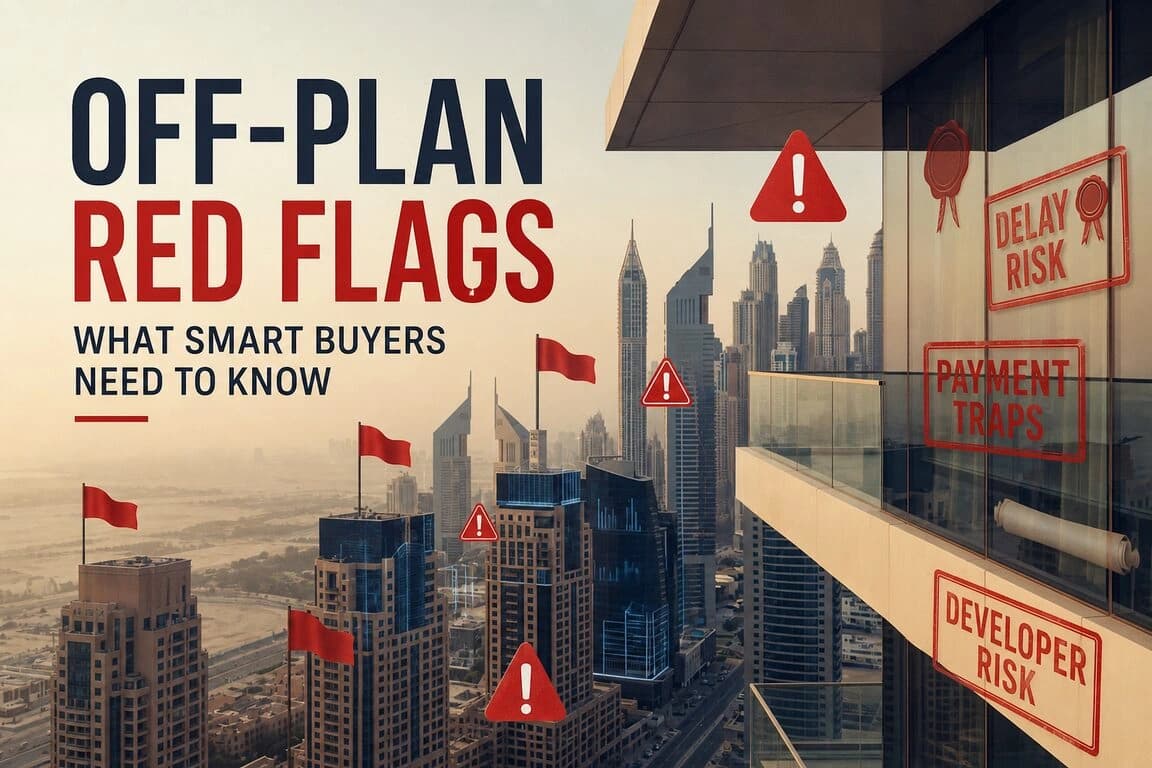
Off-plan risk (DLD)
Updated 22 Oct 2026 · first report free, then USD 1 per check or 5 for USD 5. DLD/Ejari totals and medians move every month — verify numbers in Dubai REST / Pulse before wiring money.
In one minute
The biggest Dubai off-plan warning signs are: a developer with repeated delivery delays, weak or missing Oqood registrations, escrow uncertainty, falling transaction volume, heavy price clustering, a gap between claimed sales and registered sales, and concentrated ownership near handover. Check these before you pay the reservation fee.
Why Most Investors Check the Wrong Things
Brochures show renders — DLD shows what actually registered.
Most Dubai off-plan buyers spend hours on developer websites. They compare render quality, payment plan percentages, and look up the developer's name on Google. What they almost never check — because it takes time and expertise — is the underlying transaction record: how many units actually sold, what prices they sold at, how those numbers changed over time, and what the developer's previous projects reveal about delivery risk.
That data exists. The Dubai Land Department (DLD) maintains a registry of every registered real estate transaction in the emirate — sales, mortgages, rental contracts, and Oqood registrations for off-plan units. It is the closest thing to a ground truth that exists in this market.
The seven red flags below can each be identified through DLD data. Some are obvious in hindsight. None show up in the brochure.
The 7 Red Flags
Seven DLD-visible patterns — none appear in the brochure.
No Oqood registration
Heavy marketing but minimal DLD interim registrations — legal standing absent until Oqood.
Volume cliff mid-construction
Sales stall 6–12 months after launch wave — often a funding stress signal.
Price clustering
Many units at identical AED/sqft — possible artificial demand baseline.
Developer delay pattern
Compare RERA handover dates vs title-deed registration across prior towers — systematic 12+ month slippage is the red flag.
Escrow irregularities
Payments outside DLD-registered project escrow — stop immediately.
Claimed sales vs Oqood gap
Press sell-out vs registered count — explain gaps above ~30%.
Single-entity resale block
One holder with 15%+ of units listing at handover — exit compression risk.
Red Flag 1
No Oqood Registration — or Very Few
Oqood is the DLD's interim registration system for off-plan transactions. Every legitimate sale of an off-plan unit should be recorded there. If a developer is marketing a project aggressively — running ads, hosting launch events, claiming to be "80% sold" — but DLD's Oqood system shows minimal or zero registrations, something is seriously wrong. This can mean units are being sold before the project has received RERA approval (illegal), or that the developer is misrepresenting sales volumes to create artificial urgency. In either case, you have no legal standing as a buyer until registration happens.
Red Flag 2
Transaction Volume That Drops Sharply Mid-Construction
A healthy off-plan project shows a steady pattern of registered resales and mortgages as construction progresses. When DLD data shows a sudden collapse in transaction activity 6–12 months after the first wave of Oqood registrations — with no resales, no mortgage registrations, and the developer going quiet — it often signals a funding crisis. Developers rely on buyer instalments to fund construction. If sales stall, so does the building. In 2024, DAMAC experienced this pressure acutely: of eight planned projects, only two were completed on schedule, with most facing delays extending into subsequent delivery windows.
Red Flag 3
Suspicious Price Clustering — Abnormal Concentration at One Price Point
In a normal off-plan project, DLD registered transaction prices show modest variation — different units, different floors, different dates, different buyers. When DLD data shows an abnormal concentration of transactions at precisely the same price per square foot across many units, it can indicate price manipulation: bulk transactions structured to create the appearance of demand or to establish an artificial price benchmark for future resales. DLD-based checks do not see launch prices or portal listings — only registered sale values. This red flag is about anomalies in the DLD record. Your exit price at handover — or the bank's valuation for a mortgage — may be anchored to a manipulated baseline.
Red Flag 4
Developer's Prior Projects Show a Pattern of Delays
This is one of the most reliable — and most ignored — signals in the market. DLD maintains records going back decades. Compare each sponsor's RERA-registered completion dates to when title deeds actually registered on prior towers — systematic 12+ month slippage across multiple projects is the pattern to price, not a single headline industry statistic. In 2024, median delays improved versus 2022 peaks, but large 2022–2024 launch cohorts still rolling through handover in 2026 can stress schedules — expect delay risk to stay material.
Red Flag 5
Escrow Account Issues or Non-Standard Payment Routing
Dubai law requires that all buyer payments for off-plan units go into a dedicated project escrow account managed by a licensed escrow agent. Funds are only released to the developer against verified construction milestones. In June 2024, the DLD fined three developers AED 500,000 each for unlicensed marketing and improper escrow use. When a developer asks you to pay into a personal account, a foreign account, or an account not listed on the DLD project registration — stop.
Red Flag 6
Large Gap Between Claimed Sales and Oqood Count
Some projects generate enormous press — events, celebrity appearances, sell-out claims within hours. But when you look at DLD transaction data two or three months later, registered sales (Oqood) often represent a fraction of the claimed figure. The gap between "units reserved" and "units with Oqood registration" reveals how much was real demand versus marketing. Soft launches — where units are sold before formal DLD registration — are invisible in DLD data. DLD-based checks show current Oqood-based unit counts; they do not track launch events or developers' claimed sales. To use this red flag, compare registered Oqood counts to the developer's announced volume yourself; a gap larger than 30% warrants a direct explanation.
Red Flag 7
Dominant Single-Entity Resale Block Near Handover
When DLD data shows a large block of units — often 15–30% of the total — registered to a single entity or a cluster of related entities, and those units are being actively listed for resale at or below the project's typical DLD-registered sale price as handover approaches, it can indicate: a bulk investor exiting at cost; developer-related entities holding unsold stock; or a coordinated exit strategy that will compress your resale price at handover.
"DLD data may contain errors and does not include unregistered off-plan sales (soft launches). But what it does contain is the only verifiable record of what actually transacted — not what was marketed."— Dubai Offer Verdict methodology note
Due Diligence Process: From Project to Sign
Quick Reference: The 7 Red Flags at a Glance
Severity and where to verify each flag in DLD or Dubai REST.
| # | Red Flag | Severity | Where to Check |
|---|---|---|---|
| 1 | No / minimal Oqood registrations | Critical | DLD portal · Dubai REST app |
| 2 | Transaction volume drops mid-construction | Critical | DLD transaction history by project |
| 3 | Price clustering — many units at same price | High | DLD registered sale prices by unit |
| 4 | Developer history of delays | Critical | DLD historical delivery data |
| 5 | Escrow account issues / non-standard payments | Critical | DLD project registration · Dubai REST |
| 6 | Large gap between claimed sales and Oqood count | High | Oqood count vs developer claims |
| 7 | Single-entity dominates ownership near handover | High | DLD ownership distribution per project |
What Good Looks Like: Positive Signals in DLD Data
Due diligence is not only about avoiding risk — it's about recognizing genuine quality. Alongside the seven red flags, healthy projects show consistent positive signals:
How to Actually Check These Signals
There are three ways to access DLD data — each with different depth and convenience:
Option 1: Dubai REST App (Free, Basic)
The official DLD mobile application allows you to look up individual projects, verify Oqood registrations, check ownership details, and view registered transaction prices. It requires a UAE phone number to create an account. Good for spot checks; limited for pattern analysis across multiple projects or developers.
Option 2: Manual DLD Data Analysis (Free, Time-Intensive)
DLD publishes transaction data through its portal. Sophisticated investors download raw datasets and build their own models. This approach gives you the most granular control but requires significant time — typically several hours per project.
Option 3: Dubai Offer Verdict (Free Offer Check + Paid Pack)
Use the Offer Verdict Checker first: enter the project, unit type, size, and broker ask to get a free DLD-backed price verdict. The paid report unlocks the negotiation evidence report: exact comps, broker-question script, counter-offer message, all 7 red flags, developer history, service-charge context, alternatives, and report workflow. Paid unlock is via Gumroad (card); optional Telegram for alerts only.
Check the broker offer before you chase every red flag
Enter the project, size, and quoted price; we compare your AED/sqft with recent DLD-registered resales and turn it into a clear verdict.
The free checker tells you whether the price itself is already stretched versus DLD comps. The paid report unlocks exact comps, negotiation arguments, and the deeper off-plan risk pack.
The Scale of the Problem: Why This Matters Now
Dubai's off-plan market is at a scale most international investors do not fully appreciate. Busy quarters still register tens of thousands of off-plan deals with nine‑figure‑dirham monthly totals — pull the exact slice you need from DLD or the bot rather than relying on a stale headline.
The supply wave rolling through 2026 — large projected completion pipelines citywide — creates particular pressure for projects that launched in 2022's euphoric conditions. RERA continues to sharpen escrow and default rules; banks report more frequently. These are strong protections — but they activate after something goes wrong. The seven red flags above are designed to prevent you from being in a position where you need them.
Not investment advice. All analysis based on DLD registered transaction data.
Frequently Asked Questions
The seven flags, Oqood basics, and free vs paid DLD checks.
What are the biggest red flags when buying off-plan in Dubai?
The 7 red flags in Dubai off-plan projects are: no Oqood registration, transaction volume collapse mid-construction, suspicious price clustering, developer delay history, escrow account irregularities, large gap between claimed sales and Oqood count, and single-entity ownership dominance near handover. All 7 are verifiable through DLD transaction data before you sign the SPA.
How do I check a Dubai developer's track record using DLD data?
Look at DLD's registered transactions for all previous projects by the same developer. Check delivery dates against original handover timelines in the RERA registration, verify escrow account compliance, and look for any Oqood records that show transaction volume collapsing mid-construction — a consistent sign of funding stress.
What is the Oqood system and why does it matter for due diligence?
Oqood is the Dubai Land Department's interim registration system for off-plan transactions. It is the official record that a unit sale has been legally registered before title deed issuance. A project marketing heavily but showing minimal Oqood registrations may be selling units before formal DLD approval — a significant legal and financial risk that leaves buyers without standing in a dispute.
How many Dubai developers have delayed projects?
Compare each developer's prior projects in DLD: RERA-registered completion date vs when title deeds registered. Systematic slippage of 12+ months across multiple towers is a material red flag — headline industry delay percentages vary by methodology; verify the specific sponsor's portfolio.
Can I run this due diligence myself for free?
Yes, using the Dubai REST app and the DLD transaction portal for basic lookups. For the first pricing question, use the website offer checker to compare the broker ask with DLD comps for free. A full analysis covering all seven red flags, transaction patterns, developer history, yield comparisons, exact comps, and negotiation arguments is unlocked in the paid report.
What tool checks all 7 red flags automatically?
Dubai Offer Verdict checks a broker offer with the website offer checker for free, then the paid report unlocks exact comps, negotiation arguments, developer history, all 7 red flags, yield context, and report workflow.
Investment
Where to Actually Invest in Dubai: Technical Signal Map
Market & Forecast
Dubai Rental Yields 2026: Gross vs Net, Best Areas & DLD Data
Research & Analysis
Data Source Transparency: How UAE Property Data Flows from DLD
Market & Forecast