The Metro Effect: What Dubai Transit Proximity Actually Does to Property Returns
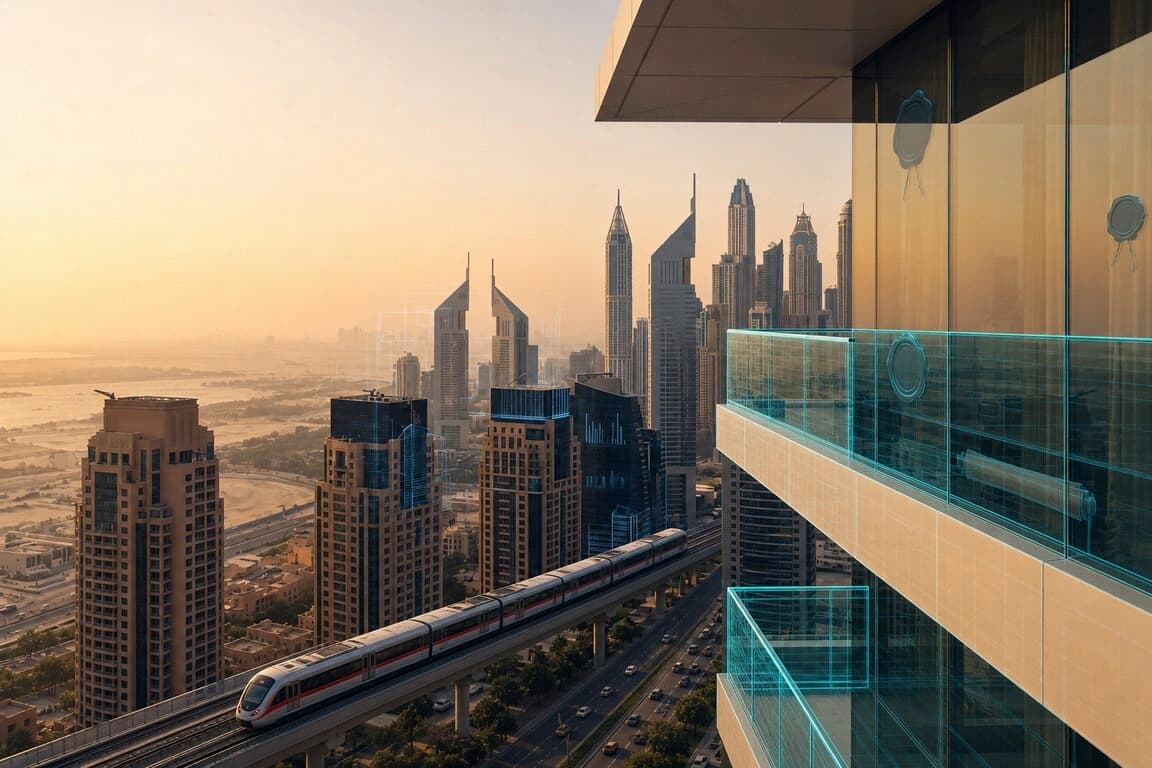
Summary
Rental velocity
Metro-linked towers often let faster — tenant pool prefers transit.
Yield ceiling
Premium for metro does not always translate to higher net yield after SC.
Blue Line 2026+
Planned corridor — price in infra timing risk, not brochure renders.
Content reviewed: May 23, 2026.
Transit adjacency accelerates rental velocity. It does not automatically improve net profitability. In high-density towers near established Metro stations, it can actively erode net yield through the service charge structures that vertical, transit-oriented development requires. Understanding the Metro Effect as a variable — with specific conditions where it works and specific conditions where it is already priced in — is what separates disciplined analysis from location-brand investing.
What the Data Shows: Velocity vs Profitability
The Metro Effect is measurable in Ejari data. Properties within walking distance of Metro stations let 10–15% faster than comparable units in the same community further from the station. In Business Bay and JLT, average days-on-market from listing to Ejari registration runs 15–25 days versus a city-wide average of 30–40 days. That is a real and consistent pattern.
Capital appreciation data from previous line openings shows a 10–30% premium in transaction prices within 2km of new stations. The widest appreciation window is in the 12–24 months around route announcement and the 6–12 months following line opening. Values between those two events — the holding period for anyone who bought at announcement — tend to be flat relative to the premium already paid.
What the gross Metro Effect data does not show: how much of the rental income those transit-adjacent buildings retain after operational costs. That is where the straightforward narrative breaks down.
Why Metro-Adjacent Towers Cost More to Own
The Dubai 2040 Urban Master Plan targets 55% of the population within 800 metres of mass transit. That is Transit-Oriented Development doctrine: cluster high-density mixed-use buildings around transport nodes to maximise infrastructure utility. The architectural consequence is vertical density — towers, not villas. And vertical towers carry structurally higher operational costs than low-rise communities regardless of their location.
High-density towers near Metro stations in JLT, Business Bay, and Dubai Marina carry service charges of AED 15–28/sqft annually. At AED 20/sqft on a 900 sqft apartment, that is AED 18,000 per year in fixed overhead before municipality fees, chiller charges, or maintenance reserves. In premium towers, service charges consume 12%+ of gross rental income.
The operational complexity is not management inefficiency — it is architectural physics. High-speed elevator maintenance contracts, centralised district cooling systems, 24/7 building management, advanced fire suppression at height, and facade maintenance on a 40-floor glass tower are structural dependencies baked into what it costs to operate the building. A villa community 3km from the nearest Metro station does not have those dependencies. Lower service charges, simpler maintenance profiles, more predictable annual cost structures.
The net yield comparison makes this concrete:
JLT 1-bedroom, transit-adjacent tower:
- Gross yield: 7.3%
- Service charges (AED 20/sqft): −1.0%
- Municipality fee: −0.35%
- Utilities and maintenance: −0.4%
- Net yield: approximately 5.55%
- Rental velocity: 20 days
Arabian Ranches 2 villa:
- Gross yield: 4.9%
- Service charges (AED 2.44/sqft): −0.2%
- Municipality fee: −0.25%
- Utilities and maintenance: −0.15%
- Net yield: approximately 4.3%
- Rental velocity: 40 days
The Metro-adjacent tower produces 1.25 percentage points more net yield and lets 20 days faster. On that snapshot, it wins. But the comparison is not static — it is a 5–10 year hold, and the Metro-adjacent tower is carrying additional risk that the villa is not.
The Speculative Timing Problem
The most common way capital is trapped by the Metro Effect is buying after announcement and before opening — paying the future infrastructure premium years before the rental growth it is supposed to deliver.
The Blue Line was announced and route-confirmed. DLD transaction prices along the corridor adjusted upward within months of confirmation. Buyers who acquired Blue Line corridor assets in 2024–2026 are holding properties with elevated acquisition costs, current rental rates that do not yet reflect Metro access, and standard vacancy timelines. They have paid for the Metro Effect 3–4 years before it is delivered.
When the Blue Line opens in 2029 and rental velocity improves and rental growth materialises, that performance will be real — but it was already capitalised into the purchase price. The arbitrage was in the corridor before widespread awareness. After route confirmation and speculative repricing, the remaining return is the standard Metro Effect on an asset already priced for it.
The investor who bought a non-Metro DSO apartment in 2023 at a 20% discount to equivalent Marina stock has been collecting 8%+ gross yield for two to three years while the Blue Line corridor repricing plays out. When the Metro opens, that asset captures the same velocity and appreciation event — from a materially lower cost basis.
The 2030 Al Sa'fat Complication
The Metro Effect analysis cannot be separated from the 2030 energy compliance timeline. Older towers near established Metro stations — particularly the Red Line corridor buildings completed between 2008 and 2015 — face a compounding risk that is not yet reflected in most DLD pricing.
Legacy MEP systems from the 2000–2010 construction era are energy inefficient by current Al Sa'fat standards. As the 2030 compliance deadline approaches, these buildings face increasing friction: buyers avoiding non-compliant stock, tenants choosing energy-efficient alternatives to reduce utility costs, and potential regulatory penalties for non-compliance. The Metro location advantage does not offset building-level technical obsolescence.
New energy-efficient completions near the same Metro stations — post-2018 construction with Al Sa'fat certification, modern district cooling connections, and smart building infrastructure — are launching at higher service charges but with lower tenant utility costs and compliance certainty. The same Metro station, two buildings, materially different 2030 risk profiles.
Metro proximity without confirmed energy compliance is a depreciating advantage in the 2026–2030 window. The building's technical condition matters as much as the station's proximity when the hold extends past 2028.
When Transit Proximity Genuinely Works
Metro adjacency generates the return it promises when four conditions are met simultaneously:
The building is operationally efficient. Post-2015 construction with Al Sa'fat compliance or clear retrofit plans, service charges below AED 18/sqft, modern MEP systems. The transit premium compounds with operational efficiency — it does not compensate for operational drag.
Entry is before speculative markup. Pre-announcement or early construction phase. Buying after route confirmation and price adjustment means paying the Metro premium before receiving the Metro benefit.
Last-mile infrastructure exists. A Metro station 800 metres away without covered walkways, pedestrian infrastructure, or temperature-controlled access points does not deliver the full velocity premium in Dubai's climate. Actual walkability matters — not just distance on a map.
The service charge structure is sustainable. The building can deliver the Metro's velocity benefit without consuming the associated rental income in operational overhead. High gross yield plus high service charges in a transit-adjacent tower can produce the same net yield as a non-transit villa — without the villa's simpler risk profile.
When all four conditions are met, transit adjacency is a genuine and durable advantage: compressed vacancy windows, expanded tenant pool, downside protection in soft markets, and appreciation correlation with infrastructure investment. When fewer than four conditions are met, it is a marketing variable priced higher than its practical effect on net returns.
The Blue Line Opportunity: Where the Arbitrage Still Exists
The 30km Metro Blue Line opening in 2029 will re-rate the eastern corridor — Dubai Silicon Oasis, International City, and the Academic City adjacent zone. DLD transaction prices in this corridor have begun repricing the catalyst but have not completed it.
Current DSO gross yields of 8.09–9.7% and International City gross yields up to 9.36% are still available at entry prices significantly below the city average. Service charge structures in the corridor are lower than equivalent-transit towers in the established Red Line communities. The buildings most relevant to the Blue Line thesis are post-2015 completions in DSO and newer International City clusters — operationally efficient assets at the right point in the speculative repricing cycle.
The entry window is now through approximately early 2027, based on how quickly the final 18–24 months before a Metro opening typically drives speculative markup to completion. The exit window is 2029–2031, after the rental velocity improvement materialises following line opening and before the next supply cycle absorbs the appreciation.
This is the actual Metro arbitrage in 2026 — not buying "Metro-adjacent" at peak hype in an established corridor, but buying infrastructure-adjacent before full repricing, in operationally sound buildings, with a defined exit window around the opening event.
Use Dubai REST / Dubai Pulse / Ejari for specific buildings in the Blue Line corridor — Ejari contract density, price per sqft trend, service charge bands, and compliance context are all verifiable from the public registers. Compare corridors against city benchmarks in the same tools before you anchor on a single tower. When you have a quoted price, run /check on this website.
Before you wire
We would not wire a deposit on portal copy alone. Pull 12-month DLD registered closes for your project and size band in Dubai REST or Dubai Pulse, then run /check on this website when you have the quoted package. Buy the paid report (USD 1, or 5 checks USD 5 on Gumroad) when you need exact comps, broker questions, and counter-offer wording for Form F or SPA review.
FAQ
Does Dubai Metro proximity increase property value? Yes, historically by 10–30% in capital values within 2km of stations, with the most significant movement in the 12–24 months around route announcement and 6–12 months after opening. However, this appreciation is typically priced in quickly after announcement. Buyers who acquire at post-announcement prices have already paid the premium before the rental growth benefit materialises.
Which Dubai Metro stations have the strongest effect on rental yield? JLT's two DMCC stations and Business Bay station produce the clearest rental velocity data — average days-to-let of 15–25 versus 30–40 citywide. However, buildings near these stations carry service charges of AED 15–28/sqft that consume a significant portion of the gross yield advantage. Net yield in JLT efficient buildings is approximately 6–7%, versus 8%+ gross yield that compresses to 4.5–5.5% net in premium towers near the same stations.
What is the Dubai Metro Blue Line and how does it affect property? The AED 18 billion Metro Blue Line is a 30km line launching in 2029, connecting the eastern corridor including Dubai Silicon Oasis, International City, and Academic City to the existing Metro network. Based on historical patterns from previous line openings, the Blue Line is expected to deliver 10–30% capital appreciation and 10–15% rental velocity improvement in the corridor around launch. DLD prices in the corridor have begun repricing this catalyst but have not completed the adjustment — the entry window for Blue Line arbitrage is approximately now through early 2027.
Is it better to buy near Metro or further away in Dubai? Depends on the capital objective and the specific asset. Metro-adjacent buildings deliver faster letting and larger tenant pools, which compounds into stronger occupancy over a hold period. But they typically carry higher service charges that compress net yields. Buildings 2–4km from Metro stations in the same communities often produce higher net yields at lower entry prices, with lower service charges and simpler operational profiles. The optimal choice depends on whether rental velocity or net margin is the priority, and on the specific building's service charge structure.
Are older Dubai Metro corridor buildings still good investments? Buildings on the established Red Line corridor completed before 2015 carry increasing risk from the 2030 Al Sa'fat energy compliance deadline. Legacy MEP systems from the 2008–2015 era face potential regulatory and tenant-preference headwinds as the compliance deadline approaches. Post-2015 construction near the same stations with confirmed energy efficiency is a materially different risk profile. Before acquiring any pre-2015 Metro-adjacent building, verify the building's Al Sa'fat compliance status and whether a retrofit programme is underway.