10 Questions to Ask Before Buying Off-Plan in Dubai
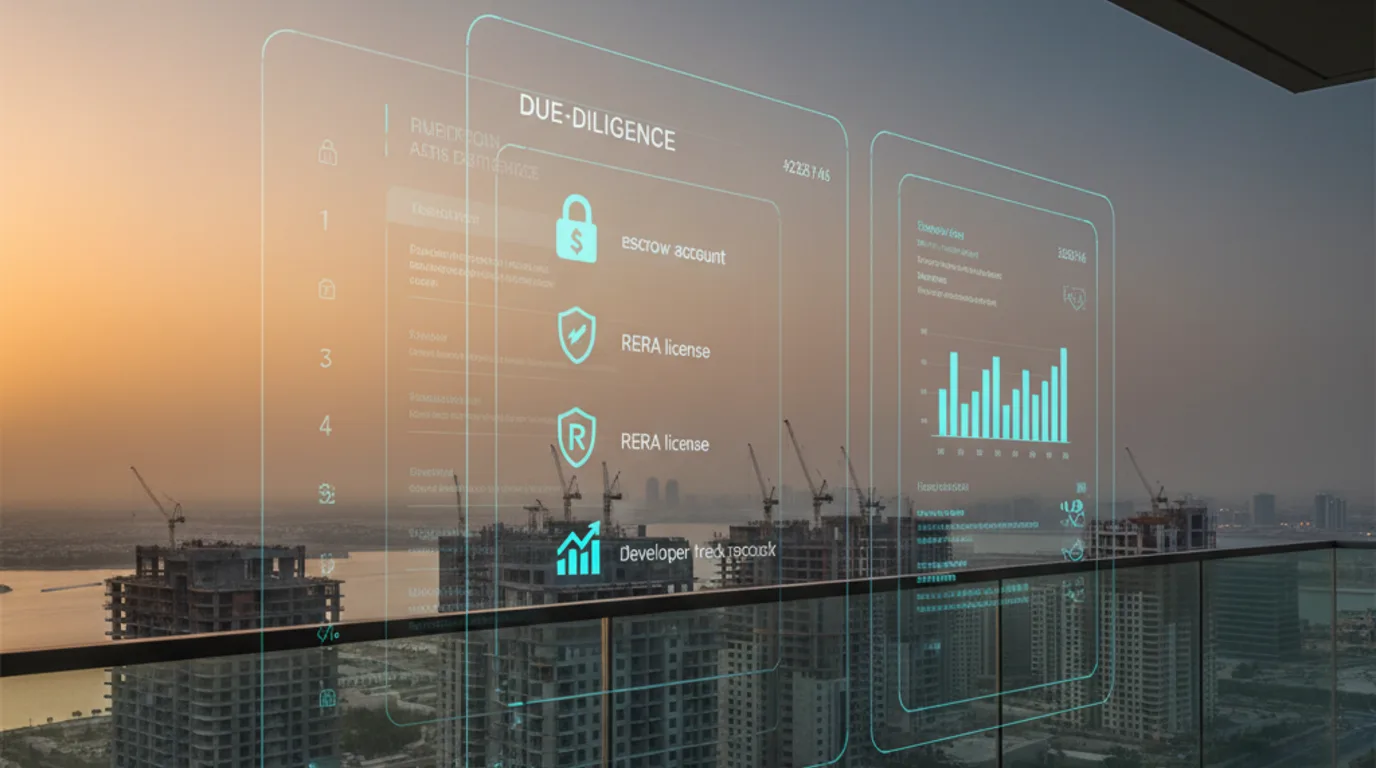
Off-plan risk (DLD)
Updated 22 Oct 2026 · first report free, then USD 1 per check or 5 for USD 5. DLD/Ejari totals and medians move every month — verify numbers in Dubai REST / Pulse before wiring money.
In one minute
Every off-plan purchase in Dubai starts the same way: a developer presentation, a floor plan, a payment schedule, and an agent telling you the project will sell out by the weekend. The questions most buyers ask at this stage — "what are the views like?" and "can I negotiate the price?" — are not the questions that determine whether the investment works.
The ten questions below are the ones that matter. For each one, the answer should come from a verifiable source — DLD registered data, RERA records, the SPA itself — not from the agent or developer selling you the unit. A good answer you cannot verify is not an answer.
Developer delivery track record
Prior projects delivered within 6 months of RERA date — verify in Dubai REST / RERA.
DLD transaction volume
50+ registrations in 12 months; rising or stable AED/sqft trend.
Escrow account
DLD-approved bank + account number in writing — disqualifier if missing.
DLD M-code
Project registration number verifiable on DLD portal — no code, no wire.
Net yield after service charges
Ejari rents minus RERA-registered SC on comparable buildings.
Payment plan + exit before handover
Milestone-linked instalments; SPA resale threshold and NOC fees.
Price vs DLD comps
Developer ask vs completed-building DLD median — not other off-plan asks.
Supply pipeline
Oqood count vs completed inventory — yield compression risk at handover.
Post-handover management
Named FM company with track record in other Dubai buildings.
Synthesis verdict
Explicit Buy or Pass from data — not "everyone is buying here."
Question 1: Has this developer delivered projects on time before?
Delivery risk is the off-plan variable — verify it in DLD, not slides.
This is the first question and the most important one for off-plan specifically. Delivery risk is the variable that differentiates off-plan from ready property, and it is entirely developer-dependent.
What you are looking for:
A developer whose prior completed projects were delivered within 6 months of their RERA-registered completion date. Consistent delivery within this window indicates reliable construction management and cash flow discipline.
Where to find the answer:
Use Dubai REST / RERA developer records for the sponsor entity. The analysis shows every DLD-registered project with expected vs actual completion dates. This is government-registered data — the developer cannot contest it or revise it retrospectively.
What a bad answer looks like: "We had some delays on our last project but the situation is different now." Two or more projects delayed 12+ months each is a pattern, not a situation. Price the expected delay into your financial model or disqualify the developer.
Question 2: What does DLD transaction data show for this project or community?
If the project has existing DLD transactions — either because it is an established community or because an earlier phase has completed — the transaction record tells you what buyers have actually paid, how consistently, and in what volume.
What you are looking for:
At least 50 DLD-registered transactions in the past 12 months in the project or immediately comparable buildings. A consistent or rising price per sqm trend over the past 4–6 quarters. Evidence that buyers are returning to the project in secondary market transactions, not just buying from the developer.
Where to find the answer:
Use Dubai REST tower-level records for building data, or Dubai Pulse / REST community data for community-level aggregates. For a quoted broker or developer price, run /check first — free DLD-backed verdict vs registered resales.
What a bad answer looks like: Thin transaction history — fewer than 20 transactions in 12 months — or a price trend that has been flat or declining for 3+ consecutive quarters. Either signals limited market conviction in the project.
Question 3: What is the escrow account number and which bank holds it?
Every legally approved off-plan project in Dubai has a dedicated DLD-registered escrow account. All buyer payments must flow to this account — not to a general developer account, not overseas, not through a third party.
What you are looking for:
The specific escrow bank name (must be on DLD's approved list) and account number, confirmed in writing before you make any payment beyond a refundable reservation deposit.
Where to find the answer:
Ask the developer directly and request it in writing. Cross-reference the bank against DLD's published list of approved escrow banks. Confirm the SPA payment schedule directs all funds to this account explicitly.
What a bad answer looks like: Any hesitation, any claim that the details are confidential, or any instruction to pay to an account other than the named escrow account. These are disqualifying responses — stop the transaction immediately.
Question 4: What is the DLD M-code for this project?
The DLD M-code is the project's government registration number — proof that DLD has approved this specific project for off-plan sales. Without it, the developer is not legally authorised to collect payments.
What you are looking for:
A specific M-code that you can verify independently on the DLD portal or Dubai REST app.
Where to find the answer:
Ask the developer or agent directly. Any registered developer selling a legitimate project will provide this immediately.
What a bad answer looks like: "It's being applied for," "we're in the process of registration," or any claim that the project is pre-registration. You should not be making payments on an unregistered project. A refundable reservation deposit only, pending M-code issuance — and even then, the registration should complete quickly.
Question 5: What is the realistic net yield after service charges?
Gross yield — annual rent divided by purchase price — is the number in every developer presentation. Net yield — what you actually keep after service charges, vacancy, and management costs — is the number that determines whether the investment works.
What you are looking for:
A service charge figure from RERA-registered records for comparable completed buildings in the same community, not from the developer's estimate. A net yield calculation that uses Ejari-registered rents rather than portal asking rents.
Where to find the answer:
Check the Dubai REST app for RERA-registered service charges on comparable completed buildings. Use Dubai REST tower tape for Ejari rental density data. The paid website analysis in Dubai Offer Verdict includes service charge data and a net yield calculation as part of the due diligence report.
What a bad answer looks like: A developer quoting AED 10/sqft service charges for a building with a rooftop pool, co-working space, padel court, and concierge. Resort amenities cost resort money to operate. If the service charge estimate looks too low for the amenity package being sold, it is. Model with a realistic estimate — comparable buildings in the community with the same amenity level — not with the developer's number.
Question 6: What is the payment plan structure — and what happens if I need to exit before handover?
Payment plans in Dubai's off-plan market range from 10/90 (10% now, 90% at handover) to 60/40, 70/30, and post-handover plans where payments continue for years after completion. Each structure has different cash flow implications and different exit mechanics.
What you are looking for:
Clear answers to three sub-questions. First, are instalments milestone-linked (triggered by construction progress) or calendar-linked (triggered by dates regardless of progress)? Second, at what payment percentage can you resell before handover, and what is the developer NOC process and fee? Third, what are the SPA terms if the developer delays — what compensation applies and what exit rights do you have?
Where to find the answer:
The SPA itself. Every payment plan detail must be in the SPA. Have a DLD-registered lawyer review the payment schedule and exit clauses specifically.
What a bad answer looks like: Calendar-linked payments with no construction milestone linkage. Resale threshold above 50% with expensive NOC fees. No specific completion date in the SPA — just a range or approximate period. Any of these terms shift risk significantly toward the buyer.
Question 7: How does this project's price per sqm compare to DLD transaction prices for comparable completed buildings?
The developer's asking price for a new off-plan unit should be benchmarked against what comparable completed units in the same community have actually transacted at in DLD records — not against other off-plan asking prices, not against portal listings.
What you are looking for:
The developer's price per sqm as a percentage of the DLD average transaction price per sqm for comparable completed buildings in the same community. A premium of 10–15% is normal for a new project with a good developer. A premium of 30–40% requires specific justification.
Where to find the answer:
Dubai Pulse / REST community slice for community DLD average. Dubai REST tower tape on comparable completed buildings in the same community for building-level transaction prices.
What a bad answer looks like: A developer who benchmarks their price against other off-plan asking prices rather than DLD completed transaction prices. "We're priced in line with the market" means nothing if "the market" is defined as other developer asking prices rather than what buyers have actually paid in DLD records.
Question 8: What is the supply pipeline in this community?
The number of Oqood-registered units in a community — units legally committed to completion but not yet built — tells you how much new supply is coming into the rental and secondary sales market over the next 2–3 years. This directly affects the yield and resale value of anything you buy today.
What you are looking for:
The total Oqood count in the community relative to the current completed inventory. A community where Oqood units represent 50%+ of completed inventory is absorbing significant new supply — rental yield compression at handover is a real risk, not a theoretical one.
Where to find the answer:
Dubai Pulse / REST community slice for the community shows the aggregate Oqood pipeline alongside completed inventory data.
What a bad answer looks like: An agent or developer who dismisses supply pipeline concerns with "Dubai always absorbs new supply." Dubai has absorbed supply well in recent cycles. It has also had periods of significant oversupply in specific communities — JVC, Business Bay, Dubai Sports City — where rental yields compressed materially as new completions arrived simultaneously. The data is the answer, not the assertion.
Question 9: Who manages the building after handover, and what are their other properties like?
The building management company determines day-to-day quality of life in the development — and significantly influences service charge efficiency, maintenance response times, and tenant satisfaction. A well-managed building retains tenants longer and attracts higher rents. A poorly managed building — slow maintenance, inefficient service charge spending, deteriorating common areas — loses tenants and depresses resale values.
What you are looking for:
The name of the appointed building management company and examples of other buildings they manage in Dubai. Ideally, visit or contact residents in those buildings to assess management quality directly.
Where to find the answer:
Ask the developer directly. For completed buildings managed by the same company, current and former tenants in JVC and other community-heavy areas often post management feedback in building-specific Facebook groups and Reddit communities. This is qualitative data — not DLD data — but it matters.
What a bad answer looks like: A developer who has not yet appointed a management company or who is using a related-party management company with no track record in Dubai. The first 12 months of building management set the service charge culture and maintenance standard for the life of the building.
Question 10: What does the price-and-risk verdict say — and do I understand why?
This is the final question — the synthesis. After working through questions 1–9, the evidence either supports moving forward or it does not. The verdict should be explicit, the reasoning should be specific, and it should come from data rather than from enthusiasm about the project.
What you are looking for:
A clear Buy or Pass conclusion based on the DLD transaction data, developer track record, price vs community benchmark, yield vs service charge calculation, and supply pipeline assessment. If you cannot state the primary reason to buy this project in one sentence grounded in data — not "it's in a great location" or "the developer is well-known" but "DLD shows 180 transactions in 12 months, 8 consecutive quarters of price appreciation, and the developer's last 3 projects were delivered within 4 months of stated date" — you are not ready to buy.
Where to find the answer:
The paid website analysis in Dubai Offer Verdict generates an explicit price-and-risk verdict for any DLD-registered project, with the specific data points that drove it. For your own checklist, the verdict emerges from working systematically through questions 1–9. If more than two of questions 1–9 produced unsatisfactory answers, the verdict is Pass — at least until the outstanding issues are resolved.
What a bad answer looks like: "Everyone is buying in this community right now." Market momentum is not due diligence. It is the condition under which the most expensive mistakes get made.
FAQ
Escrow and M-code are pass/fail; the rest build your price-and-risk model.
Should I ask all 10 questions to the agent or developer?
Questions 3, 4, 6, and 9 are best directed to the developer or agent directly — they require information only the developer holds. Questions 1, 2, 5, 7, 8, and 10 are better answered from DLD data independently — asking the developer these questions and accepting their answer without verification is not due diligence. Use Dubai Offer Verdict for the data-sourced questions, the developer for the document-sourced ones.
What if I cannot get satisfactory answers to some questions?
Questions 3 and 4 (escrow and M-code) are disqualifiers — no satisfactory answer means no purchase. Questions 1 and 6 (developer track record and SPA terms) are near-disqualifiers — a bad answer should require a significant price concession to compensate for the elevated risk. Questions 2, 5, 7, 8, and 9 are context-builders — an unsatisfactory answer on one should not stop a purchase but should factor into your pricing and risk model.
How long should answering these 10 questions take?
Questions 1, 2, 7, and 8 are answerable in under an hour using Dubai Offer Verdict. Question 3 and 4 should be answered within one developer conversation. Question 5 takes 30–60 minutes using Dubai REST and the bot. Question 6 requires SPA review — allow 3–5 business days with a lawyer. Question 9 requires qualitative research — allow 1–2 days. Question 10 is the synthesis of everything. Total: 1–2 weeks for complete answers. Any pressure to commit faster than this timeline is itself a red flag.
Can I use these questions for ready (completed) property too?
Questions 1 and 4 relate primarily to off-plan. All other questions apply equally to ready property — in some cases more reliably, because a completed building has actual DLD transaction history rather than Oqood projections, and service charges are RERA-registered rather than developer-estimated.
The agent says I must reserve today — what should I do?
Treat urgency as a red flag. The 10 questions in this guide need 1–2 weeks of verification — RERA, escrow, Oqood timeline, developer track record, and lawyer review. Walk away or insist on written proof (M-code, escrow details, SPA draft) before any non-refundable payment. Legitimate developers do not need same-day wire transfers.
Which website searches map to which of the 10 questions?
Use Dubai REST / RERA for developer delivery and registration context (Questions 1–2, 5, 7–8, 10). Use Dubai REST / Pulse for building- and community-level DLD transactions and pricing (Questions 1, 5, 7–8, 10). When you have a quoted package, use the offer checker on this website for a register-backed price verdict. Questions on payment plan legality, SPA clauses, and handover quality still need your lawyer and site visits — the article supplies DLD/Ejari facts, not legal advice.
Not investment advice. All analysis based on DLD registered transaction data and RERA public records.
Answer questions 1, 2, 5, 7, 8 and 10 with DLD data
Enter the project, size, and quoted price; we compare your AED/sqft with recent DLD-registered resales and turn it into a clear verdict.
Use the offer checker on this website for DLD-backed price verdicts on quoted packages; use Dubai REST, Dubai Pulse, Ejari, and RERA for tower and sponsor context. Paid report: USD 1 per report, or 5 for USD 5 (Gumroad) unlocks full structured evidence where enabled.