Rent Yield vs Reality: Why Advertised Dubai Yields Don't Match What Investors Receive
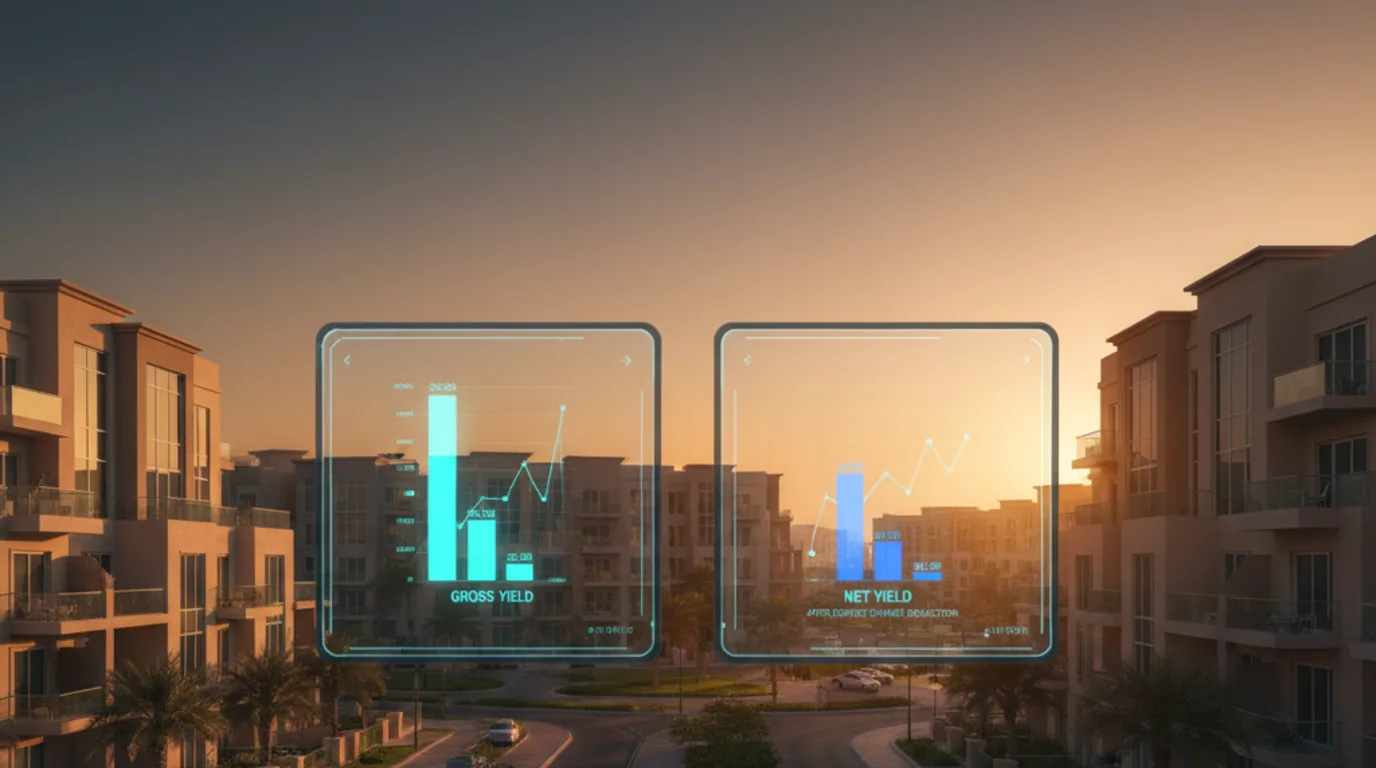
Yield and carrying costs
Updated 22 Oct 2026 · first report free, then USD 1 per check or 5 for USD 5. DLD/Ejari totals and medians move every month — verify numbers in Dubai REST / Pulse before wiring money.
Net yield requires building-level service charges — use service charge analysis or /offer-check on this website when you have a quoted unit.
Illustrative: two 700 sqft JVC studios at AED 600k purchase and AED 55k/year rent; only service charge per sqft differs.
| Layer | Bias | Fix |
|---|---|---|
| Asking rent | 8–12% above Ejari | Model on registered rent |
| Asking price | 8–13% above DLD closing | Yield on actual closings |
| Service charge | Often omitted | RERA building rate |
Content reviewed: May 23, 2026.
This gap between advertised yield and actual yield is not a small rounding difference. On a property marketed at 7% gross yield, the DLD and Ejari-based calculation typically produces 5.8–6.2% gross — before service charges, municipality fees, or vacancy. After those deductions, net yield may be 4.2–5.0% where 7% net was implied. That difference, compounded over a 5–7 year hold, is a significant portion of expected return.
This article documents where the gap comes from, how large it is across Dubai's main communities, and how to calculate yield from numbers that reflect what investors actually receive.
The Four Sources of Yield Inflation in Advertised Figures
Source 1: Portal asking price vs DLD closing price
Portal platforms — Property Finder, Bayut, Dubizzle — publish asking prices: what sellers want. DLD registers closing prices: what buyers pay. The gap between asking and closing varies by community, market conditions, and negotiating dynamics, but the consistent pattern in DLD data across Dubai's residential market is that portal asking prices run 8–13% above DLD registered closing prices.
On a property listed at AED 1,200,000, the DLD closing price is typically AED 1,050,000–1,100,000. The yield calculation using the portal price and a fixed rent produces a lower yield than the calculation using the DLD closing price. When brokers calculate yield from portal prices — which is the standard practice in most presentations — they are understating yield from the denominator.
Wait — that means using portal price understates yield? Yes: if the denominator (price) is higher than what you actually pay, the yield calculation is lower, not higher. So why is advertised yield typically higher than actual yield?
Because the numerator (rent) is also inflated from portal asking rents — and the inflation on the rent side is larger than the inflation on the price side in percentage terms, producing a net yield overstatement.
Source 2: Portal asking rent vs Ejari registered rent
Portal asking rents are what landlords advertise. Ejari registered rents are what landlords and tenants agree to and register in a government contract. The gap between asking and registered rent is typically 8–12% across Dubai's residential market — larger in communities with high supply and motivated landlords, smaller in supply-constrained transit-connected communities.
A landlord listing at AED 80,000 per year typically registers the Ejari contract at AED 70,000–74,000 after negotiation and incentives (rent-free periods, furniture, free parking). The advertised yield calculation uses AED 80,000. The real yield calculation uses AED 70,000–74,000.
Source 3: Gross vs net yield conflation
Many advertised yields in Dubai are gross figures presented without clear labelling. A "7% yield" in a broker presentation or portal listing is almost always gross — before service charges, municipality fee, and vacancy. The implicit suggestion that this is the investor's return is common. In buildings with AED 18–22/sqft service charges, the gross-to-net conversion costs 1.5–2.0 percentage points. On a gross yield of 7%, net yield may be 5.0–5.5% before vacancy.
Source 4: Vacancy assumption
Advertised yields assume 100% occupancy — 12 months of rent per year, every year. In practice, even well-located Dubai apartments experience vacancy between tenancies. A turnover period of 4–6 weeks per 12-month tenancy reduces effective annual yield by approximately 0.5–0.8 percentage points. In buildings with higher vacancy rates, the impact is larger. The advertised yield figure never includes a vacancy assumption.
The Cumulative Gap: Advertised vs Actual Yield
Combining all four sources of inflation, the gap between advertised yield and what an investor actually receives is typically 2.5–3.5 percentage points on a gross basis, and 3.5–4.5 percentage points on a net basis.
Example: JVC 1-bedroom, advertised at 8% yield
Advertised calculation:
- Portal asking rent: AED 75,000
- Portal asking price: AED 937,500
- Advertised gross yield: 8.0%
Actual calculation:
- Ejari registered rent: AED 67,000 (−10.7%)
- DLD closing price: AED 850,000 (−9.3%)
- Real gross yield: 7.9% — actually similar here because both inputs deflate proportionally
In this case the ratio holds fairly well because the asking-to-closing gap on both rent and price is similar. The real damage comes from net yield deductions:
- Service charges (AED 16/sqft on 800 sqft): −AED 12,800
- Municipality fee (5% of Ejari rent): −AED 3,350
- Vacancy (5 weeks): −AED 6,400
- Net income: AED 44,450
- Real net yield: 5.2% vs 8% advertised
Example: Business Bay 1-bedroom, advertised at 7% yield
Advertised calculation:
- Portal asking rent: AED 95,000
- Portal asking price: AED 1,357,000
- Advertised gross yield: 7.0%
Actual calculation:
- Ejari registered rent: AED 83,000 (−12.6%)
- DLD closing price: AED 1,200,000 (−11.6%)
- Real gross yield: 6.9%
Net yield deductions:
- Service charges (AED 21/sqft on 900 sqft): −AED 18,900
- Municipality fee (5% of Ejari rent): −AED 4,150
- Vacancy (6 weeks): −AED 9,600
- Net income: AED 50,350
- Real net yield: 4.2% vs 7% advertised
The Business Bay example shows the compounding effect of high service charges on a building where gross yield is not far from the advertised figure — the gap appears almost entirely in the net conversion, not in the gross calculation.
Where Advertised Yield Is Most Inflated
The communities where the advertised-to-actual gap is largest are those with high service charges, strong landlord asking power on rents (which gets negotiated down more in practice), and high portal price premiums above DLD closing levels.
Downtown Dubai and premium Marina towers show the largest gaps — advertised at 5.5–7% gross, delivering 3.0–4.5% net after service charges and realistic vacancy. The gap between the marketed figure and the net reality is 2.5–3.5 percentage points in many building-level calculations.
JVC and JLT show smaller gaps — partly because service charges are lower in efficient buildings, and partly because DLD price discovery is deep enough that portal asking prices are not as far above closing prices. A JVC building marketed at 7.5% gross often delivers 6.0–6.5% net, a 1–1.5 percentage point gap rather than 3+.
Dubai Silicon Oasis shows the smallest gaps among the mid-market communities — low service charges, lower portal premium above DLD prices, and stable Ejari rental density. A DSO building marketed at 8% gross often delivers 6.5–7% net, a more honest relationship between advertised and actual.
How to Calculate Real Yield Before Buying
Step 1 — DLD median price
Get the DLD transaction median price per sqft for the specific building in the past 12 months from DLD registered data — not from portal listings or developer price lists. Multiply by the unit's sqft.
Step 2 — Ejari registered rent
Get the Ejari registered rent for similar units in the same building in the past 12 months — not portal asking rents. This is the rent that tenants have actually committed to in registered contracts.
Step 3 — Gross yield
Divide Ejari rent by DLD price to get real gross yield.
Step 4 — Service charge
Deduct RERA published service charge (specific building, not community average) multiplied by sqft.
Step 5 — Municipality fee
Deduct municipality fee: 5% of annual Ejari rent.
Step 6 — Vacancy assumption
Apply a realistic vacancy assumption — 4–8 weeks per year depending on community and building Ejari density data.
The result is a net yield figure based on registered government data rather than portal marketing figures. /check on this website is built to benchmark a quoted package against DLD closes for matched resales; the paid pack adds negotiation evidence where enabled. For manual yield builds, combine Dubai REST closes, Ejari rents, and the RERA service charge index — gross versus net should always be labelled honestly.
Before you wire
We would not wire a deposit on portal copy alone. Pull 12-month DLD registered closes for your project and size band in Dubai REST or Dubai Pulse, then run /check on this website when you have the quoted package. Buy the paid report (USD 1, or 5 checks USD 5 on Gumroad) when you need exact comps, broker questions, and counter-offer wording for Form F or SPA review.
FAQ
Why is the advertised rental yield in Dubai always higher than what investors actually receive? Because the calculation uses portal asking rents (higher than Ejari registered rents) and portal asking prices (higher than DLD closing prices), presents gross yield without deducting service charges or municipality fees, and assumes 100% occupancy with no vacancy. Each of these inflations is individually modest — 8–12% on rent, 8–13% on price, 1.5–2% from service charges, 0.5–0.8% from vacancy — but combined they produce an advertised figure that is consistently 2.5–4.5 percentage points above what investors actually receive on a net basis.
What is the difference between gross yield and net yield in Dubai? Gross yield is annual rent divided by purchase price, before deductions. Net yield deducts service charges, municipality fee (5% of annual rent via DEWA), and a realistic vacancy allowance. In communities with low service charges (JVC efficient buildings, DSO, villa communities), gross-to-net conversion costs 1–1.5 percentage points. In communities with high service charges (Downtown, premium Marina towers, Business Bay high-service-charge buildings), gross-to-net conversion costs 2–3 percentage points or more.
What is the difference between portal rent and Ejari rent in Dubai? Portal rent is what a landlord advertises. Ejari rent is what is registered in the government tenancy contract after negotiation. The gap is typically 8–12%, reflecting rent-free period incentives, furniture packages, parking included, or direct negotiation. Ejari-registered rents are what tenants actually pay and what should be used in any realistic yield calculation. Portal asking rents produce yield figures that overstate what landlords actually receive.
How do I find Ejari registered rents and DLD transaction prices for a specific building? Both datasets are public: Dubai REST, Dubai Pulse, Ejari, and the RERA service charge index. Export the building or project slice you need. On this site, /check benchmarks an asking package against recent DLD closes for matched resales; buy the paid report (USD 1, or 5 checks USD 5 on Gumroad) when you need the full negotiation evidence rather than doing the comp sheet by hand.